
EU sustainable finance – a competitive advantage for a resilient Europe
Europe is entering a decade in which competitiveness depends on resilience, clarity of rules, and the ability of companies and investors to plan with confidence. EU sustainable finance is not an add-on to this strategy – it is one of the few areas where Europe already has global leadership and where the market outcomes demonstrate clear economic value.
1. Sustainable finance is delivering tangible economic benefits
Evidence across funds, bonds, and corporates shows that the EU sustainable finance framework is already reshaping market behaviour and strengthening long-term value creation:
- Lower cost of capital for companies with credible sustainability disclosures and transition plans.
- Oversubscribed green bonds and persistent “greenium” effects, reducing financing costs.
- The growth of sustainability-related funds, which now represent most EU funds, with resilient performance even in volatile markets.
- Growing capital expenditure aligned with the EU Taxonomy, showing that firms use the framework as strategic guidance.
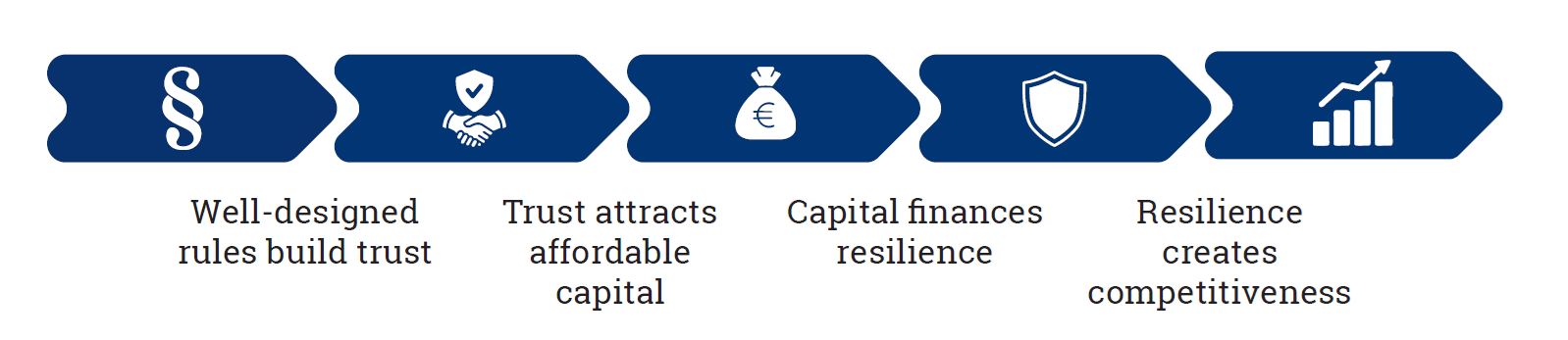
2. Europe’s advantage lies in credible, stable, high-quality rules.
The EU’s framework (EU Taxonomy, SFDR, CSRD, climate benchmarks, EUGBS) provides clarity and comparability unmatched globally. This predictability reduces risk premia, improves investment planning, and anchors Europe’s attractiveness for global capital.
3. The main risk is regulatory volatility.
The Omnibus initiative has created uncertainty by reopening rules before they were fully implemented. This undermines trust, creates sunk-cost losses for businesses, and disrupts investor decision-making. Europe cannot afford policy instability during a capital-intensive transition to a low-carbon economy.
4. Policymakers should pursue simplification – without weakening the core of the framework.
Targeted improvements should focus on alignment, consistent definitions, digital reporting, and reduced administrative friction – not dilution of standards or scope. High standards are an asset; fragmentation and uncertainty are liabilities.
5. Sustainable finance is a pillar of Europe’s strategic resilience.
In an era of climate shocks, geopolitical tension, and technological disruption, frameworks that improve risk management, strengthen transparency, and support transition investment directly enhance Europe’s resilience, sovereignty, and long-term competitiveness.
Key message to policymakers: Europe’s sustainable finance framework is working. Preserve stability, refine implementation, and avoid disruptive rollbacks. Competitiveness will come from consistent, credible rules – not from deregulation.
We also discuss this report in a podcast interview with Nathalie Dogniez, Chair of Eurosif, and Matt Christensen, AllianzGI. Listen to the episode here
